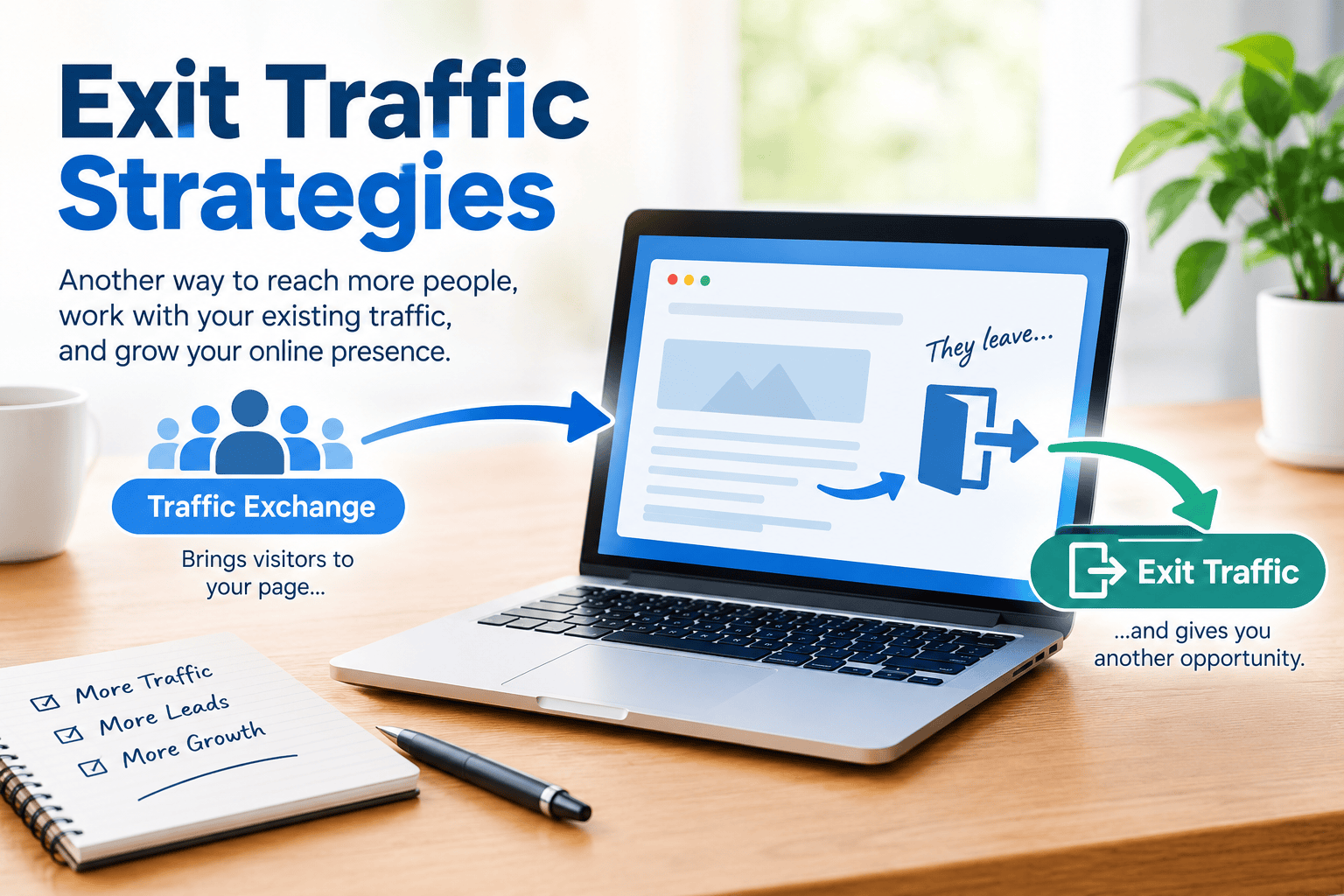
Traffic exchanges are one of the simplest ways to get a website, landing page, or other online destination in front of more people. The basic idea is straightforward: members view pages from other members, usually in exchange for credits or another form of activity that can later be used to promote their own pages. This makes traffic exchanges interesting for website owners, marketers, and anyone looking for additional ways to generate visitors without relying entirely on search engines or social media. However, getting someone to visit a page is only one part of the process. Once the visitor has seen the page, what happens next can be just as interesting.
A visitor may arrive through a traffic exchange, look at the page, and leave without taking the action you originally hoped for. They may not subscribe to your list, click your main link, purchase anything, or spend much time reading the page. That does not necessarily mean the visit was completely wasted. The visitor may simply have been looking at several pages, may not have been ready to take action, or may have found that the particular offer was not what they were looking for. This is one reason it can be useful to think beyond the first page a visitor sees and consider whether there are other relevant opportunities available as that visitor moves on.
This is where exit traffic comes into the picture. Rather than treating the end of a visit as the absolute end of the opportunity, exit traffic creates another possibility for presenting a relevant destination. The exact way this works depends on the service being used, but the basic concept is easy to understand: a person who is leaving one page may still be interested in something else related to the subject they were just viewing. Instead of focusing entirely on whether the first page produced a conversion, exit traffic gives you another way to think about the visitor journey.
Understanding the Traffic Exchange Visitor
It helps to understand why traffic exchange visitors can behave differently from visitors who arrive through a search engine. Someone who searches Google or another search engine for a specific question or topic has already expressed some level of interest. They chose to search for something and then decided to visit a particular result. A traffic exchange visitor may have a completely different reason for being on your page. They could be participating in the exchange themselves, viewing pages to earn credits, or simply browsing through the available websites.
That difference does not mean traffic exchange visitors are automatically uninterested. It simply means that their attention may work differently. Someone can be interested in online marketing, website traffic, earning opportunities, software, or another related subject without being interested in every individual offer they encounter. If you understand that distinction, it becomes easier to look at traffic exchange traffic realistically. Not every visitor is going to become a lead or customer, and that is true of many other forms of traffic as well.
The more useful question is often not simply whether the visitor converted on the first page, but whether the overall traffic strategy gives that visitor a reasonable opportunity to find something relevant. A person who does not want the first offer might still be interested in another resource. Someone who skips a particular opt-in page might respond better to an article, a tool, or a different type of opportunity. The first page may not have been the right match, but that does not automatically tell you everything about the visitor.
This is especially important when you are using traffic exchanges to promote different types of pages. A landing page, an article, a free resource, and a promotional page can all attract different reactions even when they are being shown to the same general audience. Some visitors will respond immediately, while others will simply move on. Exit traffic gives you another way to think about those visitors instead of treating the end of the first visit as the end of the entire opportunity.
Why the Exit Matters
Imagine that you are promoting a page about online marketing through a traffic exchange. A visitor arrives, looks around, and eventually leaves without signing up. From the perspective of the original page, the visitor did not take the desired action. But the visitor was still exposed to your content, and there may be another relevant destination that could be useful to them.
This is the basic idea behind combining traffic exchanges with exit traffic. The traffic exchange provides the initial exposure, while an exit traffic opportunity can potentially provide another point of exposure when the visitor is finished with the original page. The two methods therefore do not have to compete with each other. They can play different roles within the same overall strategy.
Of course, that does not mean that every visitor should be shown a completely unrelated promotion simply because an exit opportunity exists. Relevance still matters. If someone has just been reading about website traffic and then sees another resource related to traffic generation, marketing tools, or building an online audience, there is an understandable connection between the two. If the next destination has nothing to do with the visitor’s likely interests, the additional exposure may be much less useful.
That is why exit traffic is best viewed as a traffic strategy rather than simply another place to display a link. The objective is not to put something in front of as many people as possible regardless of context. It is to make better use of the opportunities that already exist within the visitor journey.
.
Traffic Exchanges and Exit Traffic Can Complement Each Other
Traffic exchanges and exit traffic generally serve different purposes. A traffic exchange is primarily concerned with getting your page in front of other users. Exit traffic is concerned with creating another opportunity around the point where a visitor leaves that page. Looking at them this way makes it easier to understand why they can work together.
For example, you could use a traffic exchange to send visitors to a marketing-related landing page. Some visitors might join your list, some might click through to another page, and others might leave without doing anything. The first two groups have already continued their journey in some way. The third group is where an additional exit opportunity may become relevant. Depending on the service and the destination being promoted, that visitor could potentially be introduced to something else that is related to their interests.
This does not mean that exit traffic should be expected to rescue every visitor who does not convert. A weak landing page will still be a weak landing page, and an irrelevant offer will still be irrelevant. Exit traffic works alongside the rest of your strategy rather than replacing it. Your page still needs to make sense, your offer still needs to be appropriate for the audience, and your traffic source still needs to be worth testing.
What exit traffic can do is add another layer to that system. Instead of thinking about traffic as a straight line where a visitor arrives, converts, or disappears, you can think about a wider journey where visitors have several possible next steps. Some people will take the first step. Others will move somewhere else. The important thing is that your traffic strategy has been designed with those different possibilities in mind.
Making Better Use of Different Traffic Sources
Another advantage of thinking about traffic this way is that it encourages a broader view of where your visitors come from. A website can receive traffic from search engines, social media, email, referrals, paid advertising, traffic exchanges, and many other sources. Each source can have a different type of visitor, and those visitors can interact with your pages in different ways.
Traffic exchanges are particularly interesting because they can provide a relatively straightforward way to generate exposure. They can be useful for testing pages, getting additional visitors, and putting a new destination in front of people who participate in these networks. At the same time, the quality and usefulness of the traffic will depend on the particular service, audience, rules, and campaign.
Exit traffic can sit alongside that activity rather than replacing it. You might use one source to bring visitors to a page and another service to create an additional opportunity when those visitors leave. In this way, the different traffic methods become parts of a larger system instead of isolated tactics.
There is also no reason to assume that you need to use every available traffic method. In fact, trying to use too many services at once can make it difficult to understand what is actually happening. It is usually more useful to test a few approaches, pay attention to the results, and gradually determine which combinations make sense for your own pages.
What to Consider When Exploring Exit Traffic
If you decide to explore exit traffic services, it is worth looking beyond the simple promise of additional exposure. Different services can operate in different ways, and the details can have a significant effect on whether a particular opportunity fits your strategy. Start by looking at the type of audience involved and whether that audience has any reasonable connection to the pages or offers you want to promote.
The format of the promotion is another consideration. Services may have different requirements concerning the type of destination you can use, the advertising format, the content of the page, or how the promotion is displayed. These rules can change, so it is always worth checking the current terms of a service before building a campaign around it.
Cost and the way you pay for exposure can also vary. Some services may use direct payments, while others may involve credits, memberships, advertising packages, or a combination of different options. The useful comparison is not necessarily the lowest price. It is whether the service provides an opportunity that fits your particular traffic strategy and whether you can reasonably track what you are getting from it.
Tracking is another important part of the process. If you are testing several traffic sources, it helps to know where visitors and clicks are coming from. Even basic source tracking can make it easier to compare campaigns and determine which traffic sources deserve more attention. Visitor numbers alone do not tell the entire story. You may find that one source produces more activity while another produces fewer visitors but attracts people who are more interested in your particular subject.
Most importantly, consider the destination itself. Exit traffic can create another opportunity, but it cannot compensate for a confusing page or an offer that does not match the audience. The traffic source and the destination need to make sense together. When they do, the additional exposure has a much better chance of being useful.
Look at the Visitor Journey as a Whole
One of the biggest advantages of thinking about exit traffic is that it changes the way you look at a visitor. Instead of seeing a person as someone who either converted or did not convert, you can look at the entire journey. Where did the visitor come from? What did they see? Did they click anything? Did they join a list? Did they continue to another page? What happened when they left?
These questions can provide a much more useful picture of your traffic strategy.
This approach is also helpful when you are working with several related pages. Perhaps you have an article that explains a traffic method, an opt-in page offering additional information, and another resource for people who want to explore the subject further. A visitor may not take the action you expected at the first step, but they may still find another part of the system useful.
That is ultimately what makes exit traffic worth considering. It gives you another way to think about the traffic you are already generating. Instead of assuming that the value of a visitor ends the moment they leave your page, you can explore whether there are other relevant opportunities available.
Exploring Exit Traffic Further
Exit traffic is not a replacement for quality content, a useful offer, or a well-designed landing page. It is simply another approach to consider when you are building a broader traffic strategy. Traffic exchanges can help generate the initial visit, while exit traffic can potentially provide another opportunity around the end of that visit.
The two approaches can therefore complement each other without requiring you to completely change the way you generate traffic. You can continue using traffic exchanges for exposure while exploring whether exit traffic services make sense for the visitors who leave your pages.
The key is to keep the strategy practical. Not every visitor will become a lead, not every traffic source will suit every website, and not every exit traffic service will be worth using. The purpose of exploring different options is to find combinations that make sense for your audience, your content, and the type of traffic you are trying to generate.
If this approach sounds interesting, you can continue exploring the subject through Exit Traffic Strategies, a focused email series covering exit traffic opportunities and related traffic strategies. It provides a simple starting point for learning more about how exit traffic can fit into a broader traffic strategy.
From there, you can explore the subject at your own pace and decide which traffic opportunities fit your current strategy. The important thing is to look at traffic as more than a single visit. A visitor arriving at your page is only one part of the journey, and what happens before and after that visit can also be part of a well-planned traffic system.